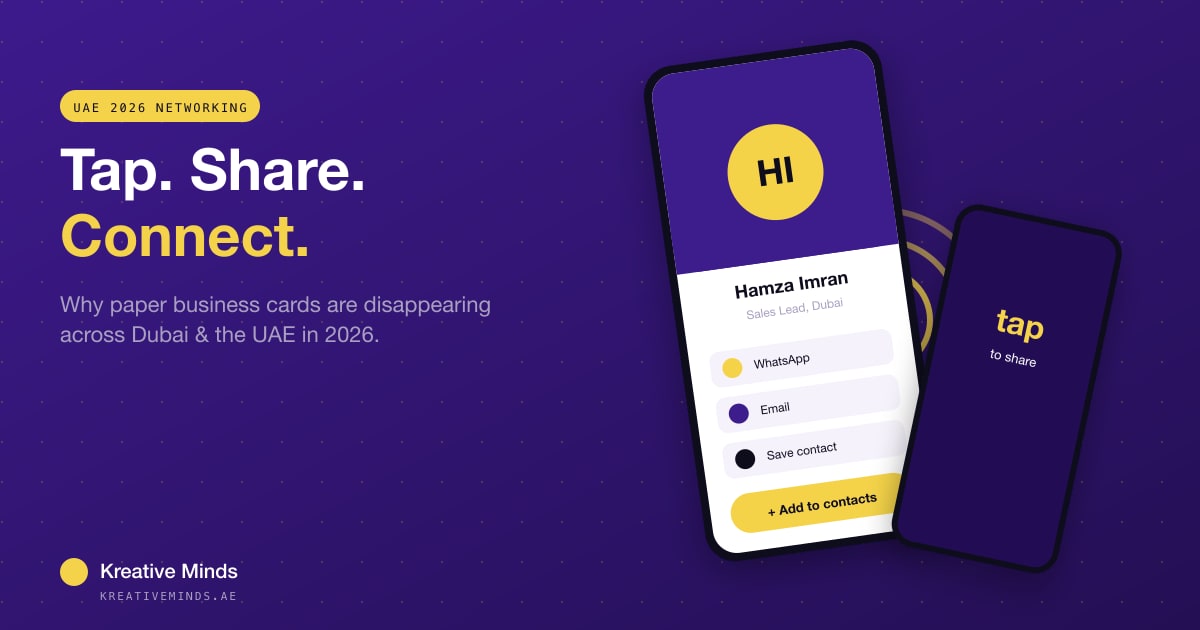
For decades, a paper visiting card was the first handshake of UAE business. In 2026 it is becoming something else: a tap, a scan, a saved contact, a follow-up that arrives before the coffee gets cold.
Digital business cards are not a gadget. They are the way professional networking is shifting across Dubai, Abu Dhabi, and the wider Gulf. The change is driven by three things: the UAE's paperless government strategy, the rise of NFC-enabled phones, and the simple fact that paper cards lose the lead 80 percent of the time.
Why paper cards are losing ground
The paper card has not failed because of style. It has failed because of math.
- Around 88 percent of paper cards collected at events are thrown away within a week, according to repeated event studies.
- Reprints cost between AED 150 and AED 600 for a small batch, every time a phone, title, or office changes.
- A paper card cannot be tracked. You do not know who saved your details and who tossed them.
- You only have it with you when you remembered to refill your wallet.
For an SMB in Dubai handing out 30 cards a week, that is hundreds of dirhams a year in print costs and most of the value going into a bin.
What a digital business card actually is
A digital business card is a single profile page that holds your contact details, links, and credentials, and that other people save by tapping a card or scanning a QR code. There are two main delivery formats:
- QR-based digital cards. A QR code that opens your profile in the browser. Works on every phone made in the last 10 years. Cost: usually free or a small subscription.
- NFC business cards. A physical card with an embedded chip that triggers your profile when tapped against another phone. Cost: AED 80 to AED 250 for a custom card.
Most serious users in the UAE end up using both. The NFC card for in-person taps and the QR code for screens, signatures, and online introductions.
The benefits Dubai professionals actually feel
- One update, everywhere. Change your title or phone number once, every contact you ever shared with stays current.
- Real analytics. See who saved your details, what they clicked, and when. Follow up with people who actually engaged.
- Faster save. A tap saves your full contact to the phone in two seconds, with no typing.
- More than text. You can include your WhatsApp, your portfolio, payment links, calendars, even a short voice note.
- Aligned with the UAE paperless strategy. Dubai has been working towards a paperless government since 2021. Your card matching that direction sends a small but real signal.
What to look for in a digital business card platform
There are many options on the market. Some are global, some are UAE-built. When evaluating a digital business card platform, the questions that matter for a Gulf professional are:
- Does it work without a special app on the other person's phone?
- Can the profile show both English and Arabic content?
- Is your data hosted with proper privacy controls? A digital card holds real contact data.
- Can you add WhatsApp click-to-chat as a primary action?
- Can you connect it to your CRM, mailing list, or calendar?
- Is the pricing fair for a solo professional, not just for enterprise?
We built MyKard with exactly this checklist in mind, but the principles apply whichever tool you choose.
How to roll out a digital card without being awkward
The most common worry we hear from UAE professionals is "will it look strange". It will not, if you do these four things:
- Set your default greeting line. Something simple, in your own voice, in English (and Arabic if relevant). Not "Welcome to my profile".
- Use a real photo, not a logo, as the main image. People remember faces, not vector marks.
- Lead with the action your audience wants. For a sales rep, that is WhatsApp. For a doctor, it is a booking link. For a founder, it might be a pitch deck.
- Carry one NFC card, plus your QR code as a phone lock-screen wallpaper. You never need to "forget cards" again.
Use cases we see across Dubai in 2026
- Sales teams at exhibitions, where every saved card becomes a lead routed straight to their CRM.
- Real estate brokers sharing listings and a callback link in one tap.
- Doctors and clinics sharing their booking link and clinic location at once.
- Restaurants and cafes showing the menu, the table reservation link, and the loyalty programme.
- Government delegations using NFC cards instead of paper at GITEX and World Government Summit.
The personal touch question
A frequent objection in the Gulf is that digital cards feel less personal. In practice the opposite is true. When you tap, the other person's screen lights up with your photo, your name, and your real story, not a piece of cardboard that disappears in their pocket. Most importantly, they get your details saved on the spot, so the relationship starts that day, not three weeks later when they "find your card somewhere".
Paper cards are not going away in 2026. But they are becoming a printed reminder of a digital handshake that already happened.
A card you hand over is just a beginning. Make sure that beginning leads somewhere your customer can act on.
If you want help designing your digital business card, integrating it with your CRM, or rolling it out to your team, our brand and marketing team can set up a clean, on-brand digital card system that fits your business.