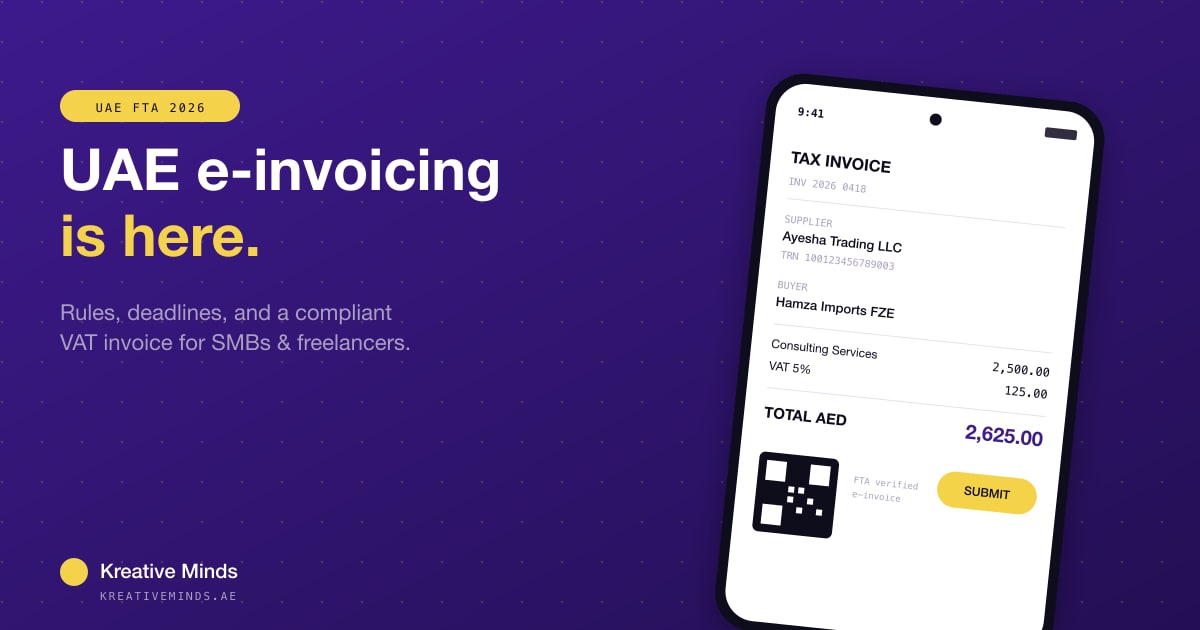
If you sell anything in the UAE, your invoices are about to change shape. The Federal Tax Authority (FTA) is rolling out a national e-invoicing framework, and the paper PDF you email today will no longer be enough.
The good news is that the rules are simpler than the noise around them suggests. This guide walks through what the FTA wants, when each phase kicks in, what a compliant tax invoice must contain, and the practical steps a small business or freelancer can take this month to be ready.
What UAE e-invoicing actually means
E-invoicing is not just sending invoices by email. It is the issue, exchange, and reporting of invoices in a structured electronic format that the tax authority can read directly. In the UAE model, invoices flow through accredited service providers, which validate them and forward the data to the FTA in near real time.
This is the same direction Saudi Arabia, Egypt, and most of Europe have already taken. The aim is to reduce VAT fraud, speed up audits, and remove the manual reconciliation that costs accountants hours every week.
For a business owner, three things matter:
- Your invoices must follow a defined XML or JSON structure, not just a free-form PDF.
- They must be signed and exchanged through an accredited service provider (ASP).
- The FTA receives a copy automatically, so what you bill is what gets reported.
The rollout phases and dates to watch
The FTA framework is phased so businesses can prepare. The official phases announced so far are:
- Phase 1 (B2G): mandatory for government suppliers from July 2026.
- Phase 2 (large taxpayers): businesses with annual revenue above AED 50 million from January 2027.
- Phase 3 (all VAT-registered businesses): rolled out through 2027 and into 2028, including freelancers and small firms.
Even if your turnover is small, you should not wait. Many enterprise clients in the UAE are already asking suppliers for compliant invoices ahead of their own deadlines, because their accounts payable systems are being upgraded now.
What a compliant UAE tax invoice must contain
Whether printed or electronic, a valid UAE tax invoice has always required a fixed set of fields. The e-invoicing standard formalises them. Here is the minimum your invoice must show:
| Field | What to include |
|---|---|
| Document title | "Tax Invoice" must appear clearly |
| Supplier details | Legal name, address, and 15-digit TRN |
| Buyer details | Name, address, and TRN if VAT-registered |
| Invoice number | Sequential, unique, no gaps |
| Issue date | And date of supply if different |
| Description | Item or service description, quantity, unit price |
| VAT rate and amount | Per line and as a total |
| Total in AED | Even if the invoice currency is different, the AED equivalent and exchange rate must be shown |
| Payment terms | Due date, bank details, or payment method |
Missing any of these can cause an invoice to be rejected by an enterprise buyer or flagged in an audit. Once e-invoicing is live, the same fields will be encoded into the XML payload sent to the ASP.
The biggest mistakes UAE businesses still make
From reviewing hundreds of invoices across our client base in Dubai and the wider GCC, the same mistakes show up again and again:
- Treating "Invoice" and "Tax Invoice" as the same thing. They are not. Without the words "Tax Invoice", the document is not VAT-compliant.
- Missing the TRN. The 15-digit Tax Registration Number must appear on every tax invoice if you are VAT-registered.
- Charging VAT without being registered. If your annual taxable turnover is under AED 375,000 and you have not voluntarily registered, you cannot add 5 percent VAT to an invoice.
- Reusing invoice numbers across years. Numbering must be sequential and unique across the life of the business.
- Issuing invoices only in a foreign currency. If the contract is in USD or EUR, the AED equivalent and the exchange rate used must still be shown.
How freelancers and small businesses can get ready in 2026
You do not need to buy a full ERP system to comply. A small UAE business or freelancer can prepare in four practical steps:
- Confirm your VAT status. If you are above the AED 375,000 mandatory threshold and not registered, register now through the FTA portal.
- Standardise your invoice template. Make sure every invoice carries every required field, in clear English (and Arabic where possible).
- Pick the right tool early. Whether you use spreadsheets, an off-the-shelf tool, or a local product like InvoiceDubai, the key is that your tool can export structured data, not just print a PDF.
- Speak to an accredited service provider. When the FTA publishes the final ASP list, choose one that connects to your invoicing tool. The earlier you connect, the smoother your Phase 3 onboarding will be.
Why this is an opportunity, not a burden
For most SMBs, e-invoicing forces a clean-up of habits that have been delayed for years. Sequential numbering, clean buyer records, and a single source of truth for revenue are good for the business, not just the FTA. Companies that have already gone through this shift in Saudi Arabia and Egypt report faster collections, fewer disputes, and shorter monthly closes once the discipline is in place.
At Kreative Minds, we help UAE businesses prepare for FTA e-invoicing as part of our wider operational and digital readiness work. That includes auditing your current invoice template, configuring tools like InvoiceDubai for your workflow, and integrating with your CRM or accounting stack so that compliance is automatic rather than manual.
E-invoicing is not a paperwork upgrade. It is a chance to fix the foundation your finance, sales, and tax reporting all sit on.
If you want help reviewing your current invoicing process or moving to a structured tool ahead of the deadlines, get in touch. We will give you an honest read on what to fix first and what can wait.