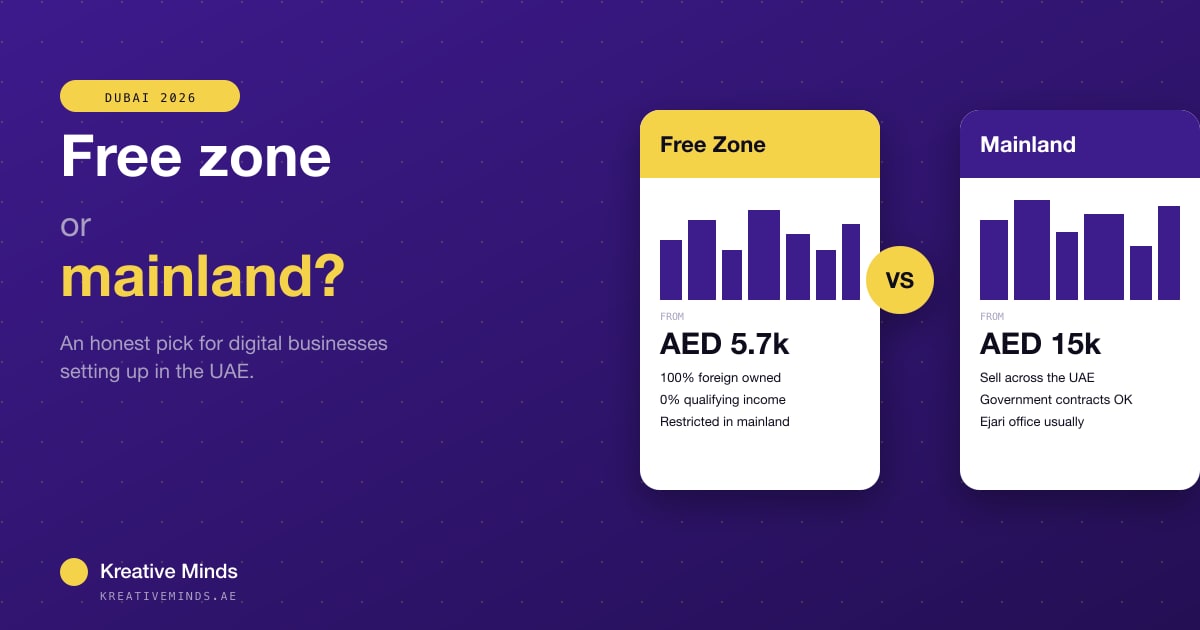
If you are about to register a business in Dubai, you will hear two phrases on repeat: "free zone" and "mainland". Both are valid. Both work. But they suit different businesses, and the wrong choice is expensive to undo.
This guide compares the two structures the way a founder actually needs them compared, in 2026, with corporate tax, the new VAT thresholds, and recent free zone reforms taken into account.
The short version
- Free zone is great if you serve clients outside the UAE, work mostly online, want a lean setup cost, and do not need a physical shop or government contracts.
- Mainland is the right call if you want to invoice UAE customers directly, take government work, open a retail or service location, or scale a UAE-facing team.
- Both now allow 100 percent foreign ownership, both can be eligible for the 0 percent corporate tax band on qualifying free zone income, and both can register for VAT.
What "free zone" actually means in 2026
A free zone is a designated economic area with its own licensing authority. There are more than 40 of them across the UAE, including IFZA, Meydan, Shams, RAKEZ, JAFZA, DMCC, and Dubai Internet City. Each one focuses on certain activities and offers its own price list.
The traditional appeal of a free zone is straightforward:
- 100 percent foreign ownership (now also available on mainland).
- Full repatriation of capital and profits.
- Simpler setup, often fully online, with a digital license.
- Eligibility for the 0 percent corporate tax band on "qualifying income" if you stay inside the regime.
The constraint that founders often miss is that a free zone company is, by default, restricted from operating in the UAE mainland market. You can serve mainland customers, but typically through a distributor, agent, or a separate mainland branch. Selling directly to a Dubai cafe or to a government entity from a free zone license is not as simple as it sounds.
What mainland means in 2026
A mainland license is issued by the Department of Economy and Tourism (DET) in Dubai, or the equivalent authority in the other emirates. Since 2021 most commercial activities allow 100 percent foreign ownership, so the old "you need a local partner with 51 percent" rule is no longer the default.
The advantages that matter for a digital or service business:
- You can invoice any client inside the UAE, including government entities, without a workaround.
- You can rent a real office anywhere in Dubai (free zone offices are limited to the zone).
- You can apply for tenders, open retail, and grow a UAE-facing sales team easily.
- Banking is often slightly smoother because banks are familiar with mainland structures.
The trade-offs are higher base costs, an Ejari office requirement for most activities, and more inspections from authorities (which is not a bad thing if your operation is clean).
A side-by-side view for digital businesses
| Topic | Free zone | Mainland |
|---|---|---|
| Foreign ownership | 100 percent | 100 percent for most activities |
| Selling inside the UAE | Restricted, usually via agent | Direct, no restriction |
| Government contracts | Not allowed directly | Allowed |
| Office requirement | Flexi-desk or shared office often enough | Ejari with physical office usually required |
| Setup cost range | AED 5,500 to AED 25,000 | AED 15,000 to AED 45,000+ |
| Visa allocation | 1 to 6 visas typical | Tied to office size, more flexible at scale |
| VAT | Required if turnover above AED 375,000 | Required if turnover above AED 375,000 |
| Corporate tax | 0 percent on qualifying free zone income, 9 percent otherwise | 0 percent on first AED 375,000, 9 percent above |
Cheapest free zones in the UAE for 2026
Price is not the only factor, but it is usually the first question a founder asks. For solo founders and small digital businesses, the most cost-effective options in 2026 are:
- IFZA (Dubai): popular for consultants and digital services, packages from around AED 12,500, modern portal.
- Meydan Free Zone (Dubai): Dubai address, packages from around AED 12,500, strong for ecommerce.
- Shams (Sharjah): media-focused, very low entry around AED 5,750 for media activities, Sharjah address.
- RAKEZ (Ras Al Khaimah): lowest overall costs in the country, strong for trading and small industrial.
- SPC Free Zone (Sharjah): simple online process, mid-range pricing.
Read the package fine print carefully. The base license fee rarely includes the immigration card, visa allocation, establishment card, or office requirements. The real cost is often AED 3,000 to AED 8,000 above the headline number.
Which one fits your business?
A few simple decision rules we use with clients at Kreative Minds:
- Your customers are mostly outside the UAE: free zone, almost always.
- You sell digital products or SaaS globally: free zone, with a clean structure to keep qualifying income in the 0 percent band.
- You sell B2B services to UAE companies: free zone can still work if your clients accept free zone invoices, but mainland is cleaner.
- You sell B2C or run physical retail, F&B, or a clinic: mainland.
- You want government or semi-government contracts: mainland.
- You expect to hire a UAE sales team of 5 or more: mainland.
Many of the strongest UAE-based digital businesses run a hybrid setup, a free zone parent and a mainland branch, but you only need that when you actually outgrow one of the two structures.
What founders should plan for, regardless of choice
Whether you go free zone or mainland, 2026 brings a few non-negotiables:
- UAE Corporate Tax registration is mandatory, even at zero profit.
- FTA e-invoicing is being rolled out, so your invoice template needs to be ready (see our UAE e-invoicing guide).
- Bank account opening is taking longer than two years ago, plan 4 to 8 weeks.
- VAT registration is required if your taxable turnover crosses AED 375,000 in any 12-month window.
At Kreative Minds we help founders pick the right structure for the business they are actually building, not the one a setup agent has in stock. We also handle the brand, web, and invoicing setup that follows so you launch with the documents and tools your customers expect.
The right answer is not "free zone" or "mainland". It is the structure that lets your customer pay you the easy way.