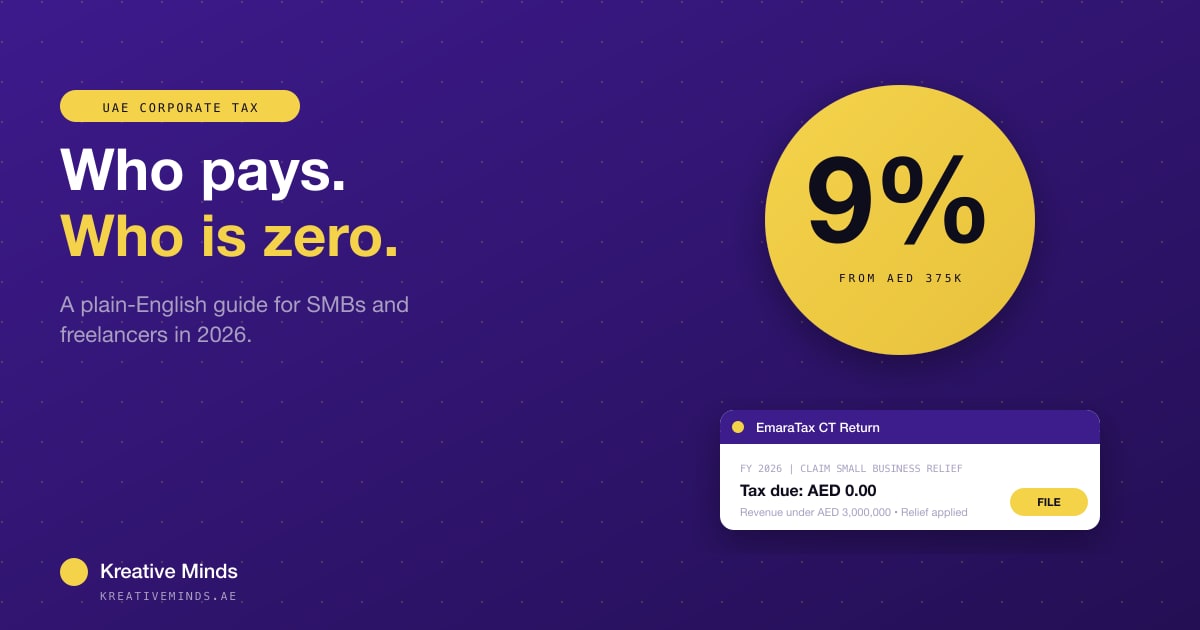
For the first time in modern UAE history, almost every business has a corporate tax filing to do. Most owners we speak to know the headline number, 9 percent, but very few know whether they actually owe anything, when to register, or what counts as taxable income.
This guide focuses on what an SMB or freelancer in the UAE needs to do in 2026, written in plain English. It is not legal advice, but it will save you a lot of unnecessary worry, and probably a lot of unnecessary fees.
The headline rules in one minute
- Standard rate: 9 percent on annual taxable profit above AED 375,000.
- Profit up to AED 375,000: 0 percent.
- Qualifying free zone income: 0 percent if you stay within the regime conditions.
- Registration is mandatory for almost every taxable person, including those whose tax will be zero.
- Filing is annual, due within 9 months of the end of your financial year.
The thing most owners get wrong: even if you owe zero, you still have to register and file.
Who has to register, even if their tax is zero
The Federal Tax Authority (FTA) made registration mandatory for all "Taxable Persons", which includes:
- All UAE-incorporated companies, mainland and free zone.
- Branches of foreign companies operating in the UAE.
- Natural persons (freelancers, sole proprietors) earning more than AED 1,000,000 per year in business or professional income.
If you are a freelancer earning under AED 1 million a year from your freelance activity, you do not need to register for corporate tax. Above that, the law treats you as conducting a business, and you must register, even if your eventual taxable profit is below AED 375,000 and your tax owed is zero.
Small Business Relief, the most useful provision you probably missed
The FTA introduced Small Business Relief specifically to give SMBs a soft landing. For tax periods up to 31 December 2026, if your annual revenue is at or below AED 3 million, you can elect to be treated as having no taxable income for that period.
In practice this means:
- You still register.
- You still file a return.
- You declare that you are claiming Small Business Relief.
- You pay no corporate tax for that year.
- You do not need to compute taxable profit in detail (no complex tax-base adjustments).
For most SMBs in Dubai, this is the single most important point in this article. If your revenue is under AED 3 million, the answer is usually "claim the relief and move on".
Registration deadlines you cannot miss
The FTA has published a phased registration calendar based on the month your trade license was issued. Missing it carries an AED 10,000 administrative penalty. This penalty has been enforced. We have seen it land on real clients.
The simple rule:
- If you missed your original window, register immediately, even now.
- If you are setting up a new company, register within 3 months of incorporation.
- Freelancers who cross AED 1 million should register within 3 months of crossing the threshold.
How to file a UAE Corporate Tax return as an SMB
The process is built around the EmaraTax portal. The high-level steps:
- Register on EmaraTax and add a Corporate Tax registration to your business profile.
- Confirm your financial year. Most SMBs use the calendar year, January to December.
- Maintain proper books. A simple bookkeeping tool, plus structured invoices (see our e-invoicing guide), is enough for most SMBs.
- Prepare your annual financial statements. Free zone companies often need audited statements. Mainland SMBs under AED 50 million revenue usually do not.
- File the return on EmaraTax within 9 months of your year-end.
- Pay any tax due by the same deadline. If you are claiming Small Business Relief, this step is zero.
What actually counts as taxable income
Taxable income is your accounting profit, adjusted for a small number of items the law treats differently. The most common adjustments for SMBs are:
- Personal expenses run through the company are added back.
- Dividends from UAE companies are exempt.
- Foreign branch profits can be exempt if elected.
- Some interest expense is restricted.
- Entertainment expenses are deductible at only 50 percent.
For most small UAE businesses, the gap between accounting profit and taxable profit is small. The fancy tax planning that consultants love to talk about mostly matters at AED 50 million plus.
Free zone companies, the catch most owners miss
"0 percent in a free zone" is not automatic. To keep the 0 percent rate, a free zone company must qualify as a Qualifying Free Zone Person (QFZP). The main conditions:
- Maintain adequate substance in the free zone (real people, real activity, not a mailbox).
- Earn Qualifying Income, mostly transactions with other free zone persons or specific qualifying activities.
- Stay within the de minimis non-qualifying income limit (the lower of 5 percent of total revenue or AED 5 million).
- Maintain audited financial statements.
- Comply with transfer pricing.
The moment you fail any of these tests, you flip to the 9 percent rate for the whole period. Free zone is still attractive, but it is not "free", and the QFZP rules need real attention.
Mistakes we see most often
- Assuming "free zone" means "no tax". The QFZP rules need real attention.
- Treating personal spending from the business account as a business expense.
- Not registering because "we will not owe anything anyway".
- Missing the 9-month filing deadline because "the accountant is on it" without checking.
- Mixing the founder's freelance income and the company's revenue in one bank account.
What an SMB should do this quarter
- Register on EmaraTax if you have not already.
- Decide whether you will claim Small Business Relief for this tax period.
- Get your bookkeeping clean. A simple ledger is enough for most SMBs.
- Standardise your invoices for VAT and the incoming e-invoicing rules.
- Diary the filing deadline in your business calendar today.
Most UAE SMBs need 10 to 20 hours of admin and a fair invoicing tool to get fully ready. The cost of getting it wrong, in penalties and stress, is far higher.
Corporate Tax in the UAE is not a trap. It is a system that rewards businesses that keep clean books and act early.
If you need help getting your invoicing, bookkeeping, and tax registration aligned, our team at Kreative Minds can audit your current setup and recommend the simplest path to compliance. We have done this work alongside many UAE SMBs, and the answer is rarely as complicated as it sounds.